 Superagents Labs
Fintech · Web app and Telegram bot
ChartGuru
AI-powered market analysis for stocks, crypto, FX and metals. Taken from idea to live MVP in eight weeks.
30,000+ users
Read the case study →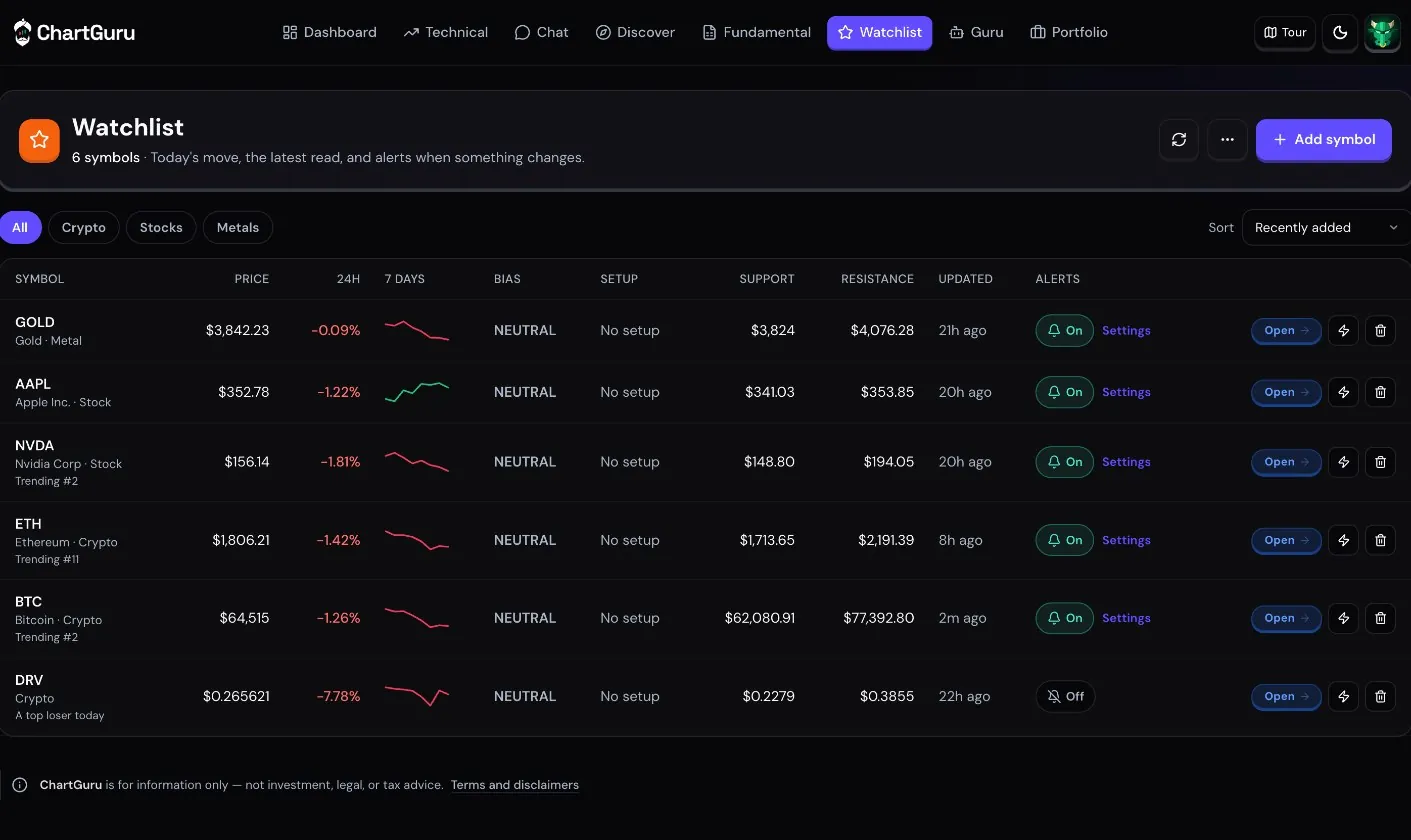
Comparison
Use an AI app builder such as Lovable, Bolt, Replit or v0 to test an idea quickly and cheaply. Hire a freelancer for a small, well-specified job. Choose a large agency for big, multi-team programmes. Choose a senior studio such as Superagents Labs when the product must take payments, handle user data and grow with real customers.
| Dimension | AI app builder | Freelancer | Large agency | Senior studio |
|---|---|---|---|---|
| Upfront cost | A monthly subscription. Your own time is the main cost. | Usually the lowest cost for paid engineering. Rates vary widely. | The highest, because you pay for a larger team, management and process | A fixed price for an agreed scope. Web MVPs from about $16,000. |
| The cheapest start is not always the cheapest finish. Count rework and delay as well as the first invoice. | ||||
| Speed to a first version | Hours to days for a working prototype | Depends on the size of the job and one person’s availability | Usually months, with discovery and onboarding first | 2–8 weeks for a launch-ready MVP |
| AI builders are fastest to a demo. A product customers can rely on and pay for is a different finish line. | ||||
| Who owns and can maintain the code | You can usually export the code. Maintaining it is down to you. | You own it if the contract says so. Upkeep depends on that person staying available. | You own it under contract. Changes usually go back through the agency. | You own it, in your own repository, written so other engineers can pick it up |
| Whoever builds it, put ownership of the code and the repository in writing before work starts. | ||||
| Security and data access | Generated defaults. Access rules and secrets need a careful review before real user data goes in. | Depends on the individual’s experience. Ask how they handle it. | Usually covered by formal reviews and QA | Sign-in, database access rules and secrets set up by senior engineers from day one |
| If the product holds personal data, someone experienced must check exactly who can see what. | ||||
| Payments and production readiness | A simple checkout can work. Subscriptions, webhooks, staging and monitoring usually need an engineer. | Works well as a defined task, such as adding Stripe to an existing app | Covered, as part of a larger and longer engagement | Payments, separate staging and production, and error tracking built in |
| Taking money from customers raises the bar. Failed cards, refunds and renewals all have to work. | ||||
| When you need to change things | Small changes by prompt are fast. Larger ones can break other parts of the app. | Quick if they are free. If not, you wait or find someone new. | A change request, an estimate and a slot in the schedule | The same senior team keeps building after launch |
| Your product will change after launch. Plan for who makes those changes, not only who builds version one. | ||||
| Best for | Validating an idea, demos and internal tools | Small, well-specified jobs | Large, multi-team programmes | Products that take payments, handle user data and need to scale |
| Many founders use more than one: an AI builder to learn, then engineers to launch. | ||||
Upfront cost
Speed to a first version
Who owns and can maintain the code
Security and data access
Payments and production readiness
When you need to change things
Best for
Comparing studios, agencies and offshore teams? Read boutique vs agency vs offshore →
AI app builders such as Lovable, Bolt, Replit and v0 turn a written description into a working app. That changes the first step for a founder. You can test an idea in days, for the price of a subscription, without hiring anyone.
They generate real code rather than a locked visual model, and most let you export it. That makes them a strong way to validate an idea, build a demo for investors or make a small internal tool.
The gaps tend to appear when real users arrive. Sign-in works in the demo but breaks on edge cases. Database access rules can leave one user’s data visible to another. A checkout works once, but subscriptions, refunds and failed cards do not. Pages slow down as the data grows.
None of this means the prototype was a mistake. It means the next stage needs someone who can read the code, find the gaps and fix them without breaking what already works. That is what our prototype to production service is for.
A freelancer gives you one skilled person, usually at a lower total cost than a team. That works well when the job is clear and you can manage it yourself. The trade-off is capacity and cover: one person can only do so much, and if they move on, the knowledge goes with them.
An agency gives you a team, a process and a contract that does not depend on one person. Large agencies suit large programmes. A senior studio sits between the two: a small team of experienced engineers, a fixed scope and price, and direct access to the people writing the code. Our boutique vs agency vs offshore comparison goes deeper on that choice.
We price every build as a fixed scope for a fixed price. Web MVPs start from about $16,000, and most focused MVPs cost $15,000–$40,000, depending on the number of core workflows, the platforms and the integrations. Most launch in 2–8 weeks.
The MVP cost calculator gives you a range in two minutes. If you are not sure the idea is ready, a product validation sprint tests it first, in one to two weeks.
See how we run MVP development, or how we take AI-built prototypes to production. If you are interviewing freelancers or studios, our checklist for choosing a software development company lists what to ask before you sign.
The common path
Many founders now do both. They build a first version in an AI app builder, put it in front of real people, then bring in engineers before launch. It is a sensible path: you learn cheaply, and you only pay engineers for the parts that need them.
01
Build the core flow yourself in Lovable, Bolt, Replit or v0. Keep it small and focused on one job.
02
Show it to potential customers. Learn what they use, what they ignore and what they would pay for.
03
Before launch, have engineers review the code, sign-in, database access rules, secrets and payments.
04
Fix what is fragile, rebuild only what cannot be saved, and go live with monitoring in place.
Products this team scoped, designed and built. ChartGuru went from idea to live MVP in eight weeks. Instalogo launched in six.
Fintech · Web app and Telegram bot
AI-powered market analysis for stocks, crypto, FX and metals. Taken from idea to live MVP in eight weeks.
30,000+ users
Read the case study →AI agent · Telegram
An AI agent that creates and manages brand assets for crypto communities, inside Telegram. Launched in six weeks.
5,000+ communities
Read the case study →
A freelancer usually costs less upfront, because you pay for one person rather than a team and its management. The total cost depends on how well the work is specified and how much rework follows. For a scoped MVP, our senior studio builds web MVPs from about $16,000, and most focused MVPs cost $15,000–$40,000 at a fixed price.
It can be the start of one. Lovable is very good for prototypes and early versions, and it generates real code you can export. Before you take payments or store personal data, have an engineer review sign-in, database access rules, secrets and payments. Many founders keep their Lovable app and harden it rather than starting again.
Yes, for a prototype, a demo or a simple internal tool. AI app builders such as Lovable, Bolt, Replit and v0 make that possible without writing code. Founders often hit limits with authentication, database access rules, payments and scaling, which is the point to bring in experienced engineers.
Use an AI app builder to test the idea and learn what customers want. Hire developers when the product needs to take payments, handle user data or support real usage. Many founders do both: they prototype with AI, then bring in engineers to make it production-ready.
No-code and AI app builders let you build quickly with little or no programming, within the limits of the tool. Custom development means engineers write and own the code, so you control the architecture, security and integrations. No-code suits early tests. Custom development suits products that need to scale or meet strict requirements.
Usually, yes. These tools generate standard code, often React with a database such as Supabase, that an experienced engineer can read and extend. A good first step is a code and security audit, so you know what to keep, what to fix and what to rebuild.
When the job is small, clearly specified and fits one person’s skills, such as a landing page, an integration or a single feature. A team makes more sense when the work spans design, front end, back end and infrastructure, or when the product is still taking shape.